Starting an online store in the UAE can cost a few hundred dirhams or tens of thousands of dirhams, depending on what you already have and how you choose to launch.
A retailer that already has the appropriate business license, products and brand may only need to pay for an online store, domain and basic marketing.
Someone starting an entirely new ecommerce business may also need to budget for company formation, licensing, inventory, packaging, payment processing, delivery and customer acquisition.
So there is no single answer to:
How much does it cost to start an online store in the UAE?
A better way to calculate it is:
Business setup + online store + domain + products + payments + delivery + marketing + contingency
For a new ecommerce business, the business license is often one of the largest fixed startup costs. Publicly advertised UAE free-zone ecommerce packages in 2026 vary considerably, with some starting around AED 5,750 and others around AED 12,500 or more, depending on the authority, activities and package.
If you already operate a properly licensed UAE business, however, your cost of adding an online sales channel can be dramatically lower.
This guide breaks down the major expenses one by one so you can build a realistic budget before spending money.
Important: The figures in this guide are planning estimates and examples, not quotations. Licensing, visas, banking, logistics, payment services and other costs depend on your business structure and providers. Always confirm current requirements with the relevant UAE authority or service provider before purchasing.
Quick Cost Breakdown for Starting an Online Store in the UAE
Here is a practical overview.
| Expense | Typical planning approach |
|---|---|
| Business/ecommerce licence | Around AED 5,750–12,500+ in current free-zone examples |
| Ecommerce platform | From AED 0/month with Storexio; paid plans from AED 79/month |
| Domain name | Usually a relatively small annual cost; .ae pricing varies by registrar |
| Product inventory | Depends completely on your product and sourcing model |
| Product photography/content | Can start DIY or use professional services |
| Online payments | Usually charged per successful transaction |
| Packaging | Depends on product type and branding |
| Delivery | Usually becomes a per-order operating cost |
| Marketing | Can start organically and increase as you validate demand |
| Accounting/tax/compliance | Depends on business structure, revenue and provider |
The biggest mistake is looking only at the price of the website.
Your online store is only one part of the ecommerce business.
For many merchants, inventory, licensing and acquiring customers eventually cost more than the ecommerce platform itself.
1. Business and Ecommerce License Cost
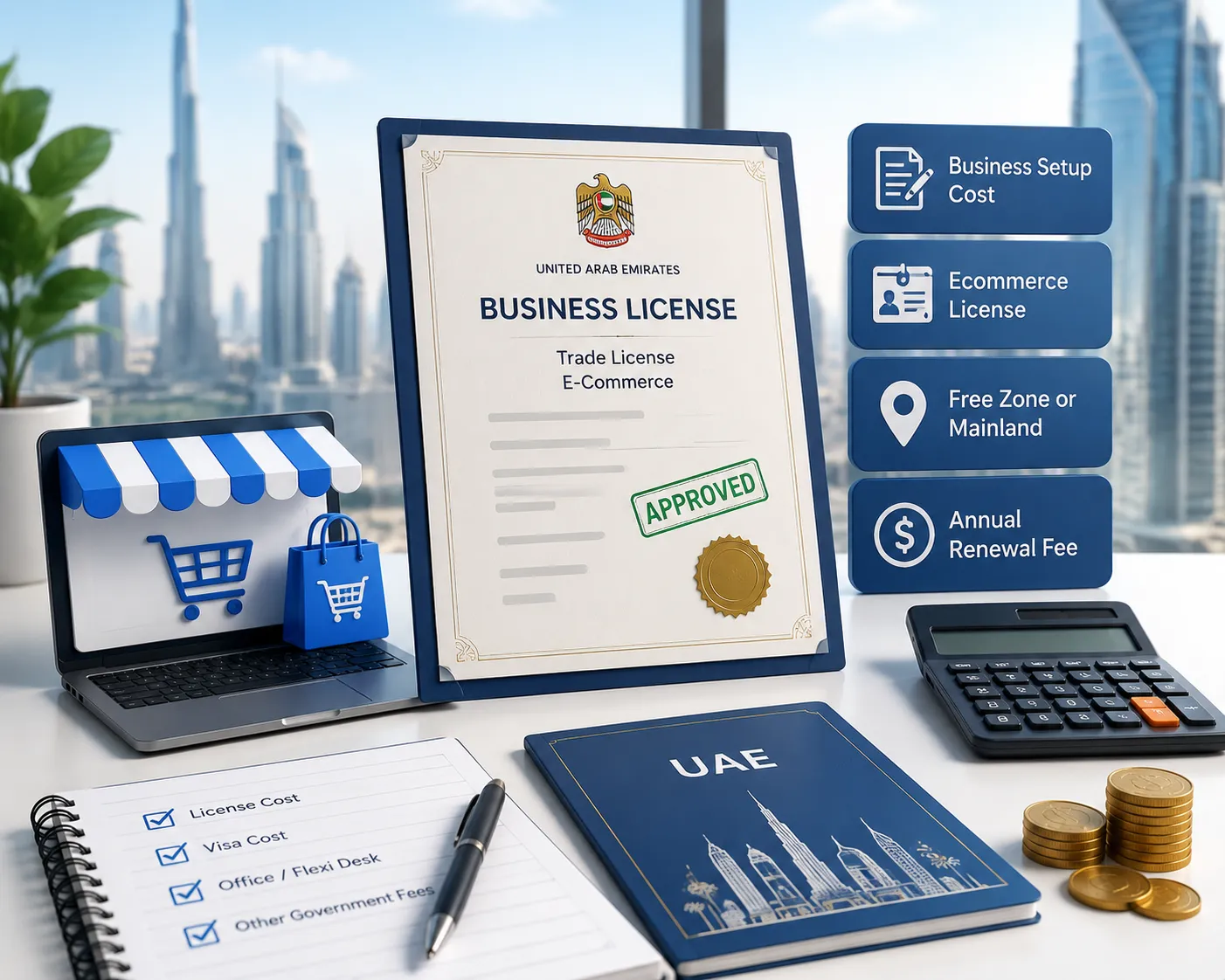
Before budgeting for your website, determine whether you already have the appropriate business activity for selling online.
The UAE regulates ecommerce activity, and businesses selling goods or services online generally need the necessary licence and approvals for their activity.
The exact cost varies significantly according to:
Mainland or free zone, emirate, business activities, number of shareholders, visa requirements, office or flexi-desk requirements, and additional approvals.
For example, publicly advertised 2026 packages provide a useful illustration of how different the starting price can be.
Sharjah Publishing City Free Zone advertises an ecommerce business license package starting from approximately AED 5,750.
Meydan Free Zone currently advertises its standard business license from approximately AED 12,500, with different packages and optional services available.
These figures should not be interpreted as the price of every ecommerce license in the UAE.
They demonstrate something more important:
Your legal setup can change your startup budget by thousands of dirhams before you upload your first product.
If you already operate a retail or trading business, check whether your existing license covers the online activity you want to conduct before opening another company unnecessarily.
If you are starting from zero, compare the full package rather than only the advertised license price.
A cheaper headline price may exclude something you need later, such as a visa, establishment services, additional activities or other operational requirements.
2. Online Store and Ecommerce Platform Cost
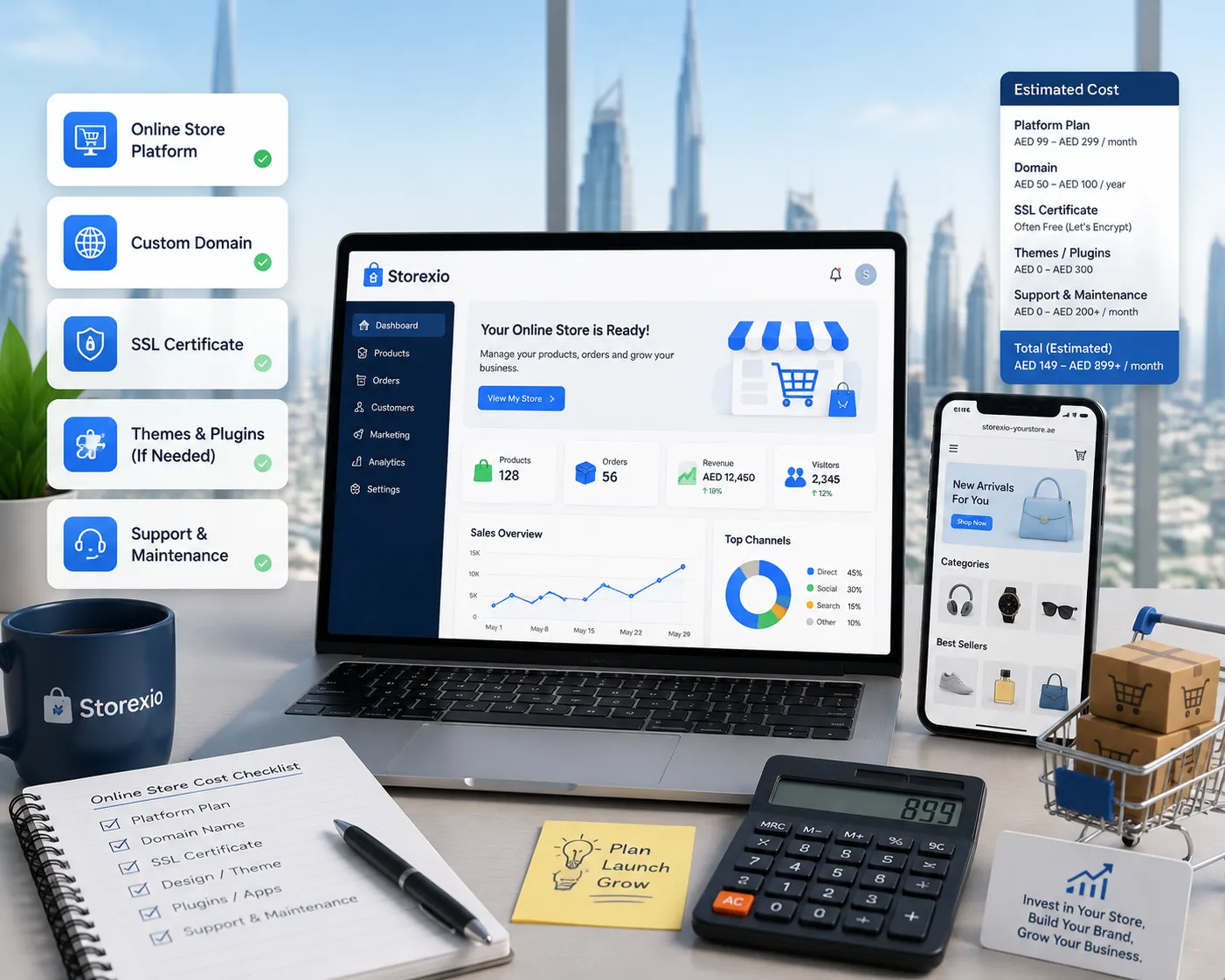
The second cost is your actual storefront.
There are several ways to build one.
You could commission a custom ecommerce website, use an international website builder, install an open-source ecommerce system, or use a ready ecommerce platform.
For a new business, the important question is not:
“What is the most advanced website I can build?”
It is:
“What is the simplest reliable store I can launch, manage and improve as orders grow?”
Custom development can make sense when a business requires unusual integrations, workflows or highly specific software.
But many new UAE merchants initially need something much simpler:
Products, categories, product pages, a professional storefront, mobile shopping, order management, payment configuration, promotions and a custom domain.
This is where a ready online store builder for UAE businesses can substantially reduce the initial technical cost.
Storexio cost example
As of August 2026, Storexio provides a Free plan, allowing a new merchant to begin testing an online storefront without an initial platform subscription.
Paid Storexio plans currently start from AED 79 per month, with larger plans adding higher catalog limits and additional ecommerce capabilities.
That means you do not necessarily need to spend several thousand dirhams on custom development before discovering whether customers actually want your products.
A lean strategy is:
Launch → validate demand → improve → upgrade when the business requires it.
That is usually a better use of startup capital than building an expensive system before generating your first orders.
You can see the full process in our guide on how to create an online store in the UAE.
3. Domain Name Cost
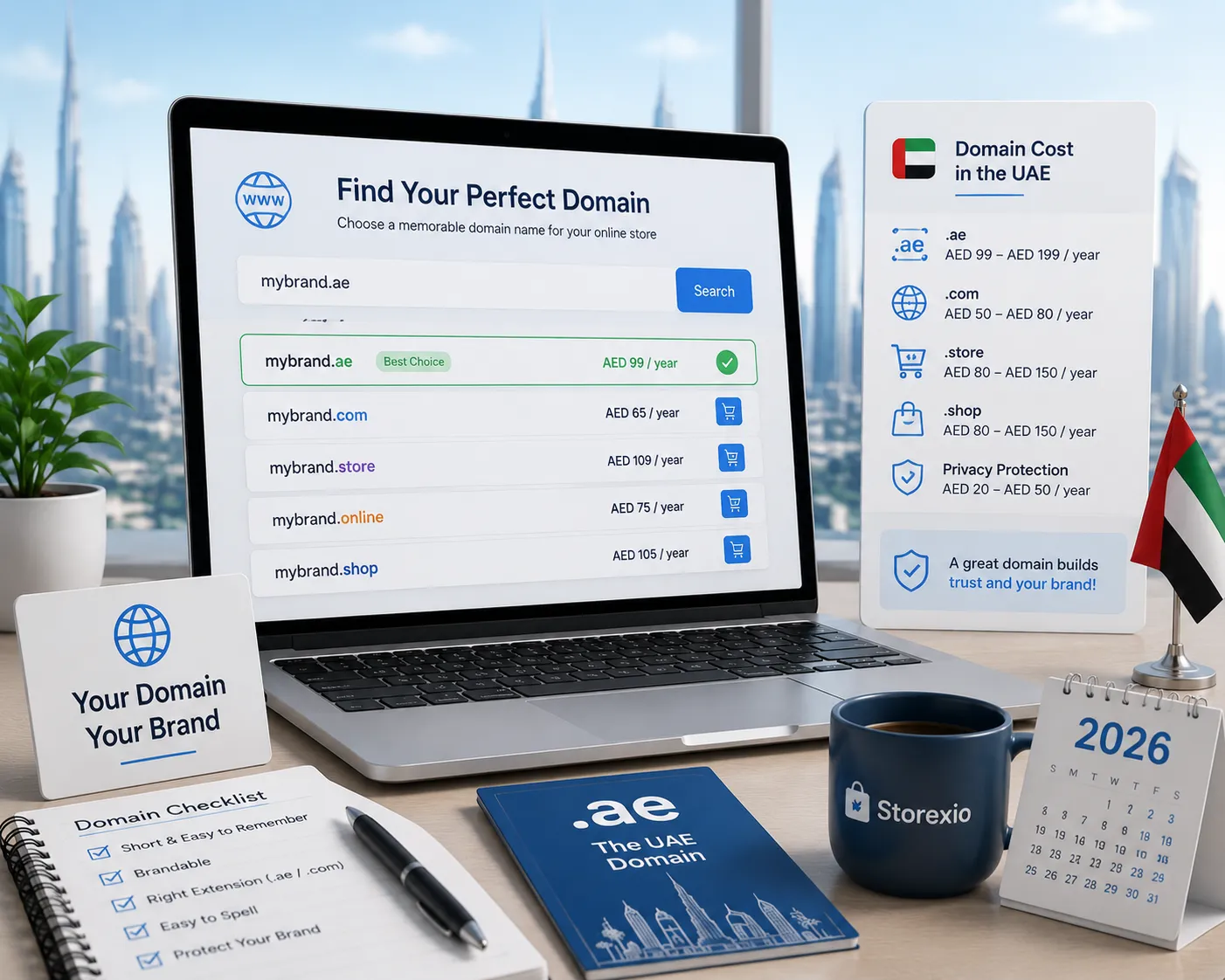
Your domain is your store's web address.
For example:
yourbrand.ae
or:
yourbrand.com
A custom domain is normally one of the smaller costs in an ecommerce launch, but it is worth budgeting for because it helps create a more professional identity.
The UAE's official country-code domain is .ae, and .ae domains are registered through accredited registrars.
Prices vary because each registrar sets its retail pricing.
For example, some UAE registrars currently advertise .ae registrations at roughly AED 125–129 per year, while prices for .com domains can be lower or higher depending on the registrar and promotion.
Do not choose your registrar based only on the first-year promotional price.
Check:
renewal price, ownership details, DNS management and transfer conditions.
Most importantly, make sure your business is listed as the domain registrant.
Your domain is an asset. You should control it.
Some eligible Storexio paid annual plans also include domain benefits, which can reduce this separate expense.
4. Product Inventory
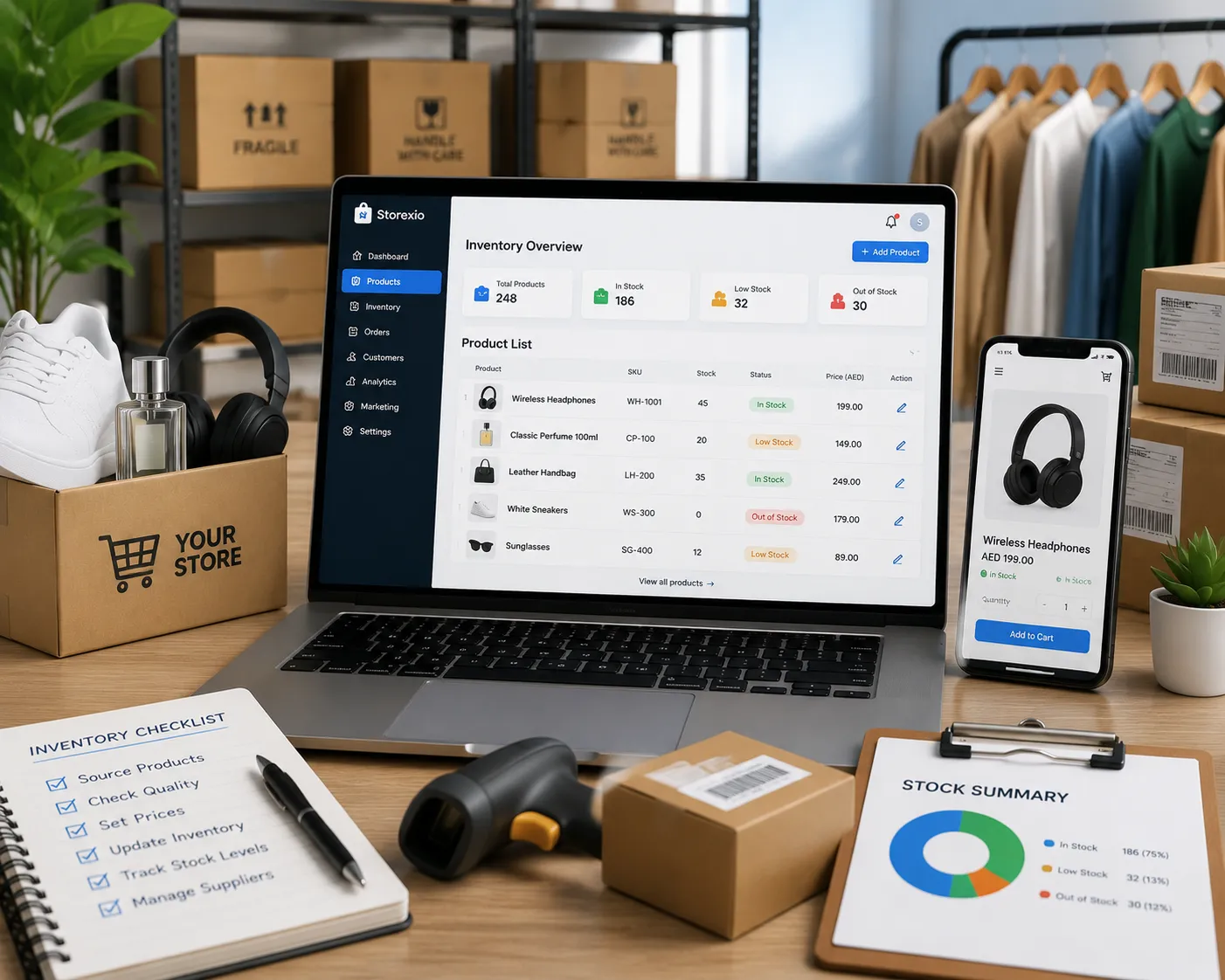
For many ecommerce businesses, stock is the largest startup expense.
There is no useful universal figure because the cost of launching:
a perfume business,
a fashion brand,
an electronics shop,
a flower store,
and a grocery business
can be completely different.
Instead of asking:
“How much stock should I buy?”
ask:
“What is the smallest inventory that allows me to test real demand?”
Suppose you have AED 10,000 available.
Spending AED 8,000 immediately on 80 different products may leave you with little money for:
- licensing,
- packaging,
- content,
- delivery,
- payment expenses,
- advertising,
- or replenishing the products that actually sell.
A smaller initial catalog can often be more useful.
For example, you could launch with 10–20 carefully selected products, measure which products receive views and orders, and then increase inventory around proven demand.
Your online store does not need hundreds of products on launch day.
It needs products customers actually want to buy.
5. Product Photography and Content
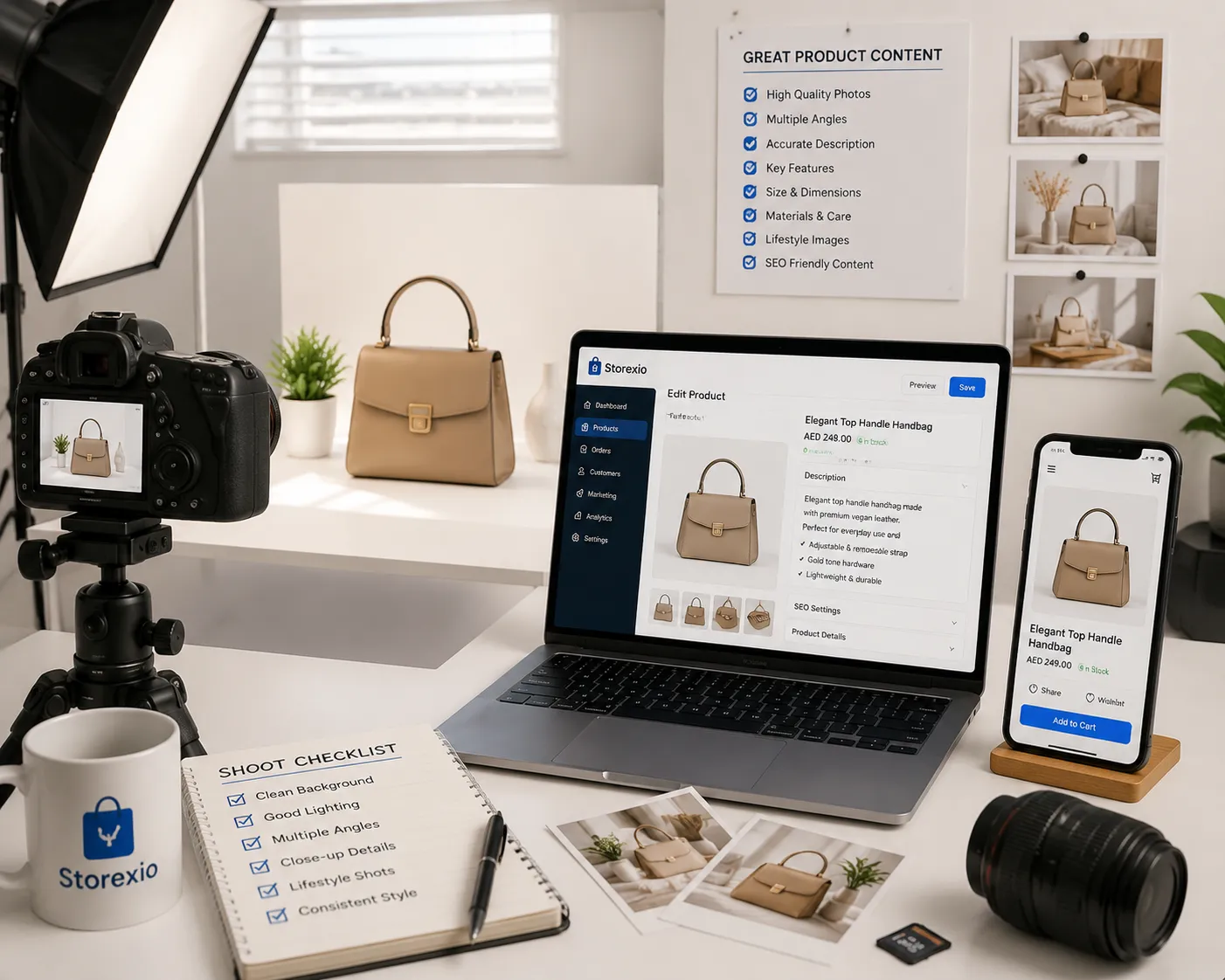
Customers cannot physically touch your products online.
Your images, descriptions and product information therefore do part of the job that a salesperson would perform inside a physical shop.
You can approach this expense in three ways.
DIY
Use a good smartphone, natural lighting and a clean background.
This can reduce your initial content cost significantly.
Hybrid
Photograph the products yourself but pay for selected editing, banners or campaign graphics.
Professional
Hire a photographer or content team when premium visual presentation is important to your category.
Perfumes, jewelry, fashion, beauty products and home décor can benefit particularly strongly from high-quality presentation.
Whatever method you choose, every important product should ideally have:
clear photographs, an understandable product name, price, description, relevant specifications, variations where applicable, availability and delivery information.
Do not spend heavily on advertising while your product pages still make customers uncertain.
6. Payment Processing Costs
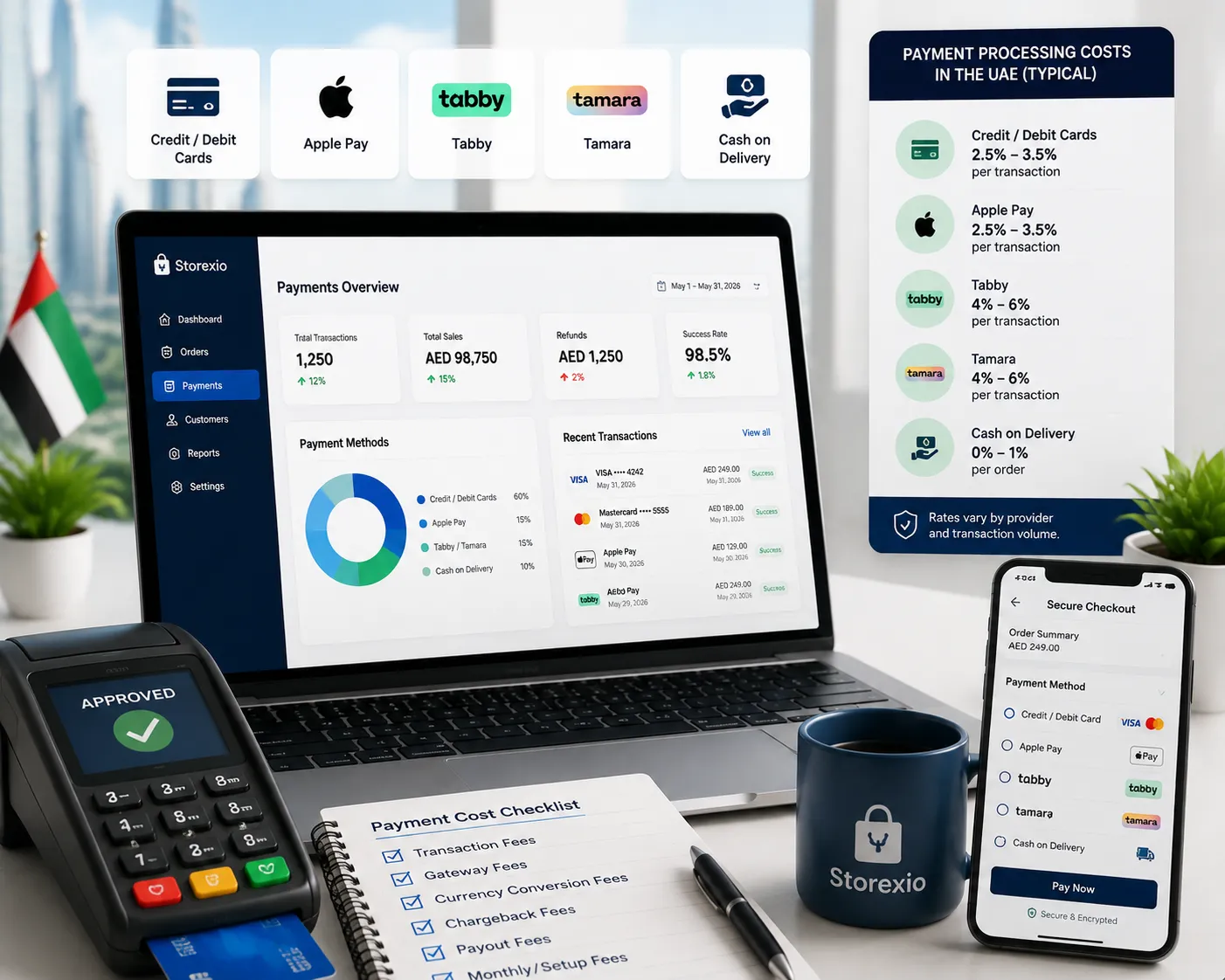
Taking card payments usually introduces a variable cost rather than only a startup cost.
Payment providers commonly charge a percentage of the transaction plus a fixed amount.
As one current UAE benchmark, Stripe's standard domestic-card pricing is 2.9% + AED 1 per successful transaction.
Other UAE gateways use different commercial structures.
Some may have:
- setup fees,
- monthly fees,
- transaction charges,
- minimum commitments,
- international card fees,
- currency conversion fees,
- or negotiated rates.
This means payment processing should be built into your gross margin.
Imagine you sell an item for AED 100.
Your real calculation is not simply:
AED 100 selling price − AED 50 product cost = AED 50 profit.
You may also have:
payment fee + packaging + delivery contribution + advertising cost + returns + operating expenses.
Understanding contribution margin becomes increasingly important as the store grows.
Storexio supports different payment workflows depending on your selected plan and configured gateway, while cash-on-delivery workflows can also be used where appropriate.
7. Delivery and Fulfilment Cost
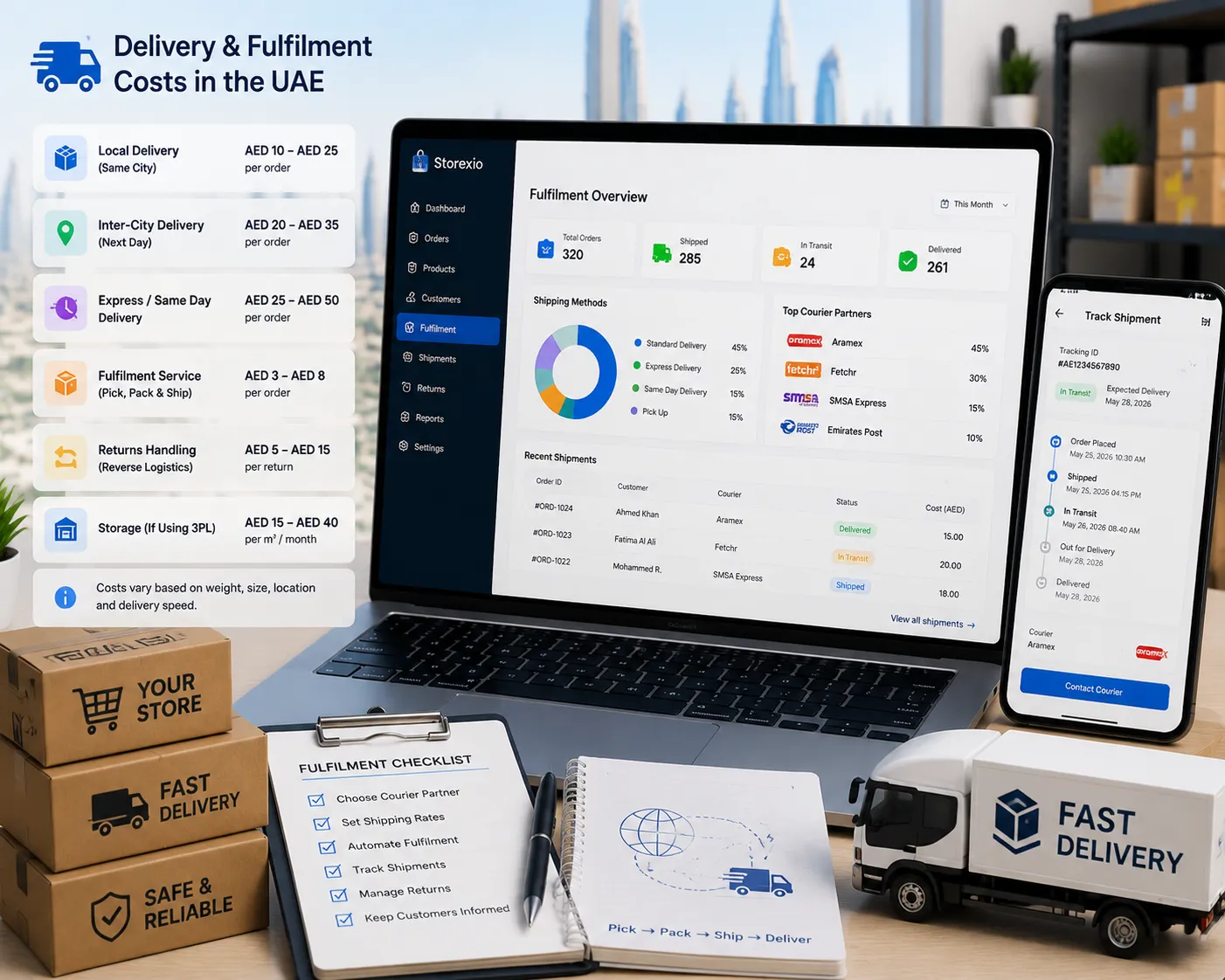
Delivery is another area where many first-time online sellers underestimate cost.
The cheapest delivery quote is not always the cheapest option for your business.
Consider:
delivery price, collection schedule, delivery speed, COD handling, failed-delivery charges, return-to-origin fees, remote-area surcharges and customer support.
You can usually approach fulfilment in three stages.
Very early stage: arrange deliveries manually or through an on-demand courier.
Growing stage: negotiate with a courier based on regular monthly volume.
Higher volume: use more structured fulfilment or warehousing arrangements.
Do not build your retail price without knowing approximately what each successful order costs to fulfil.
8. Packaging
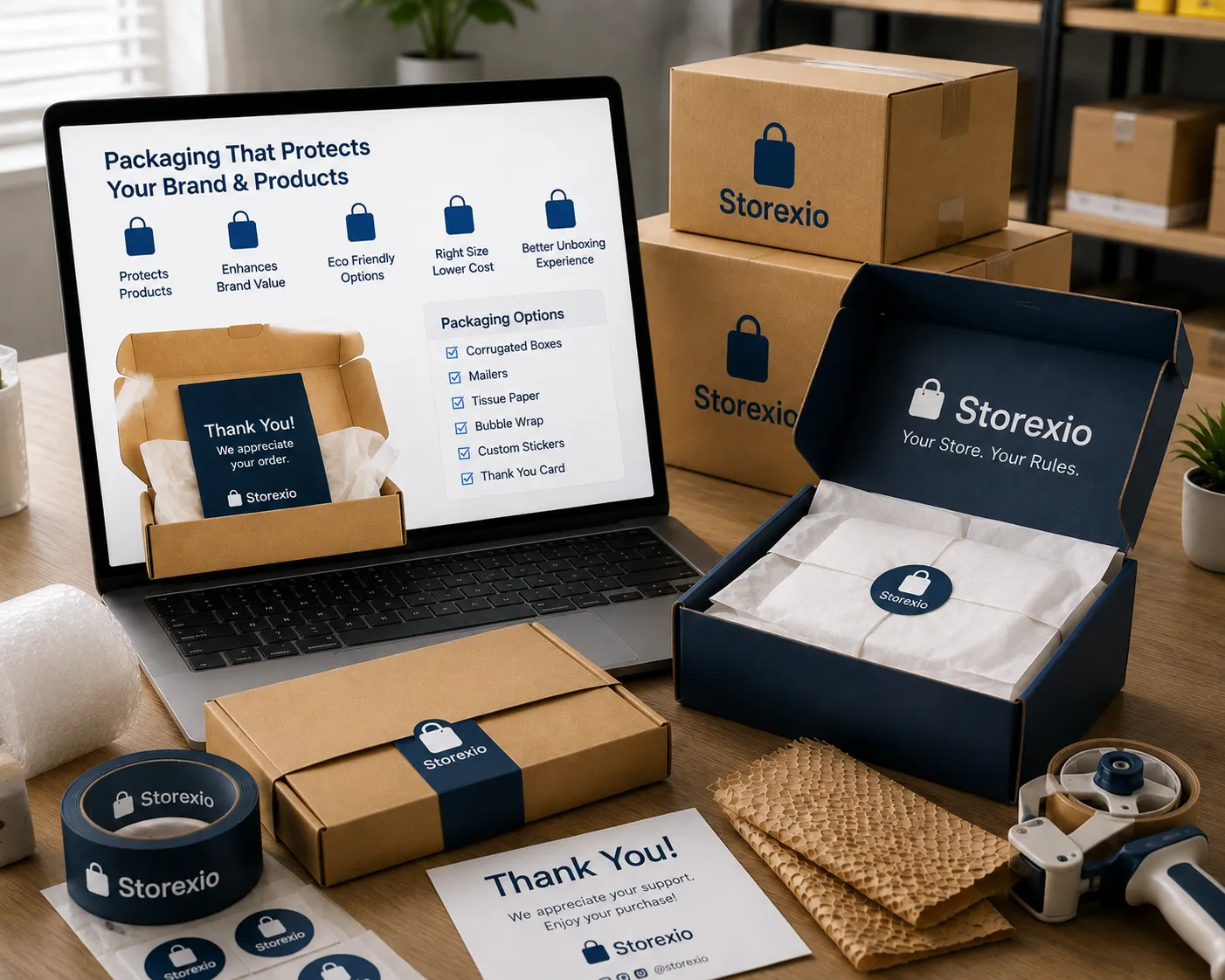
Packaging is easy to overlook because one box or bag seems inexpensive.
At volume, it becomes a meaningful cost.
Your packaging might include:
shipping box or bag + product protection + branded sticker + printed card + tape + receipt/invoice materials.
You do not need luxury packaging from day one.
Protect the product properly first.
Then improve the unboxing experience as the brand grows.
For fragile categories such as perfume, glassware, electronics or decorative products, damage prevention is more valuable than decorative packaging.
9. Marketing Budget
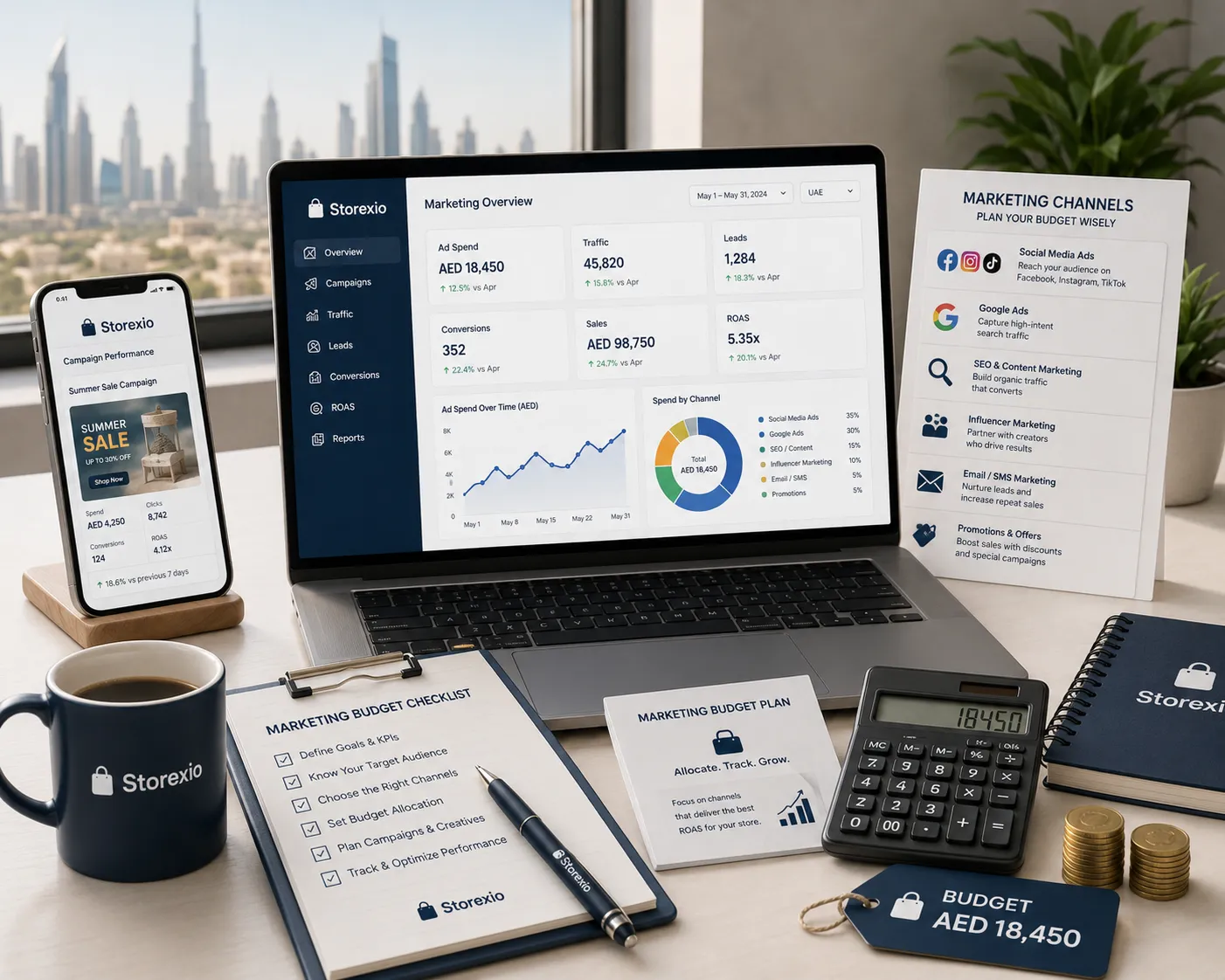
Building your ecommerce website does not automatically generate customers.
You need a plan for getting people to the store.
Your initial channels could include:
Instagram, TikTok, Google Search, Google Shopping, WhatsApp, SEO, influencer collaborations, existing customers and offline store traffic.
You do not need to launch on every channel simultaneously.
Pick one or two that fit the product.
For example:
A visually interesting gadget may work well through short-form video.
A customer actively searching for a specific product may be better reached through Google.
A business with an existing physical store can encourage existing customers to reorder through its website.
For a new business, I would treat the first marketing budget as a testing budget, not as a promise of sales.
The purpose is to learn:
Which product attracts attention?
Which message earns clicks?
Which page converts?
What is the cost of acquiring an order?
Once you know those answers, increasing the budget becomes much more rational.
10. Tax and Compliance Costs
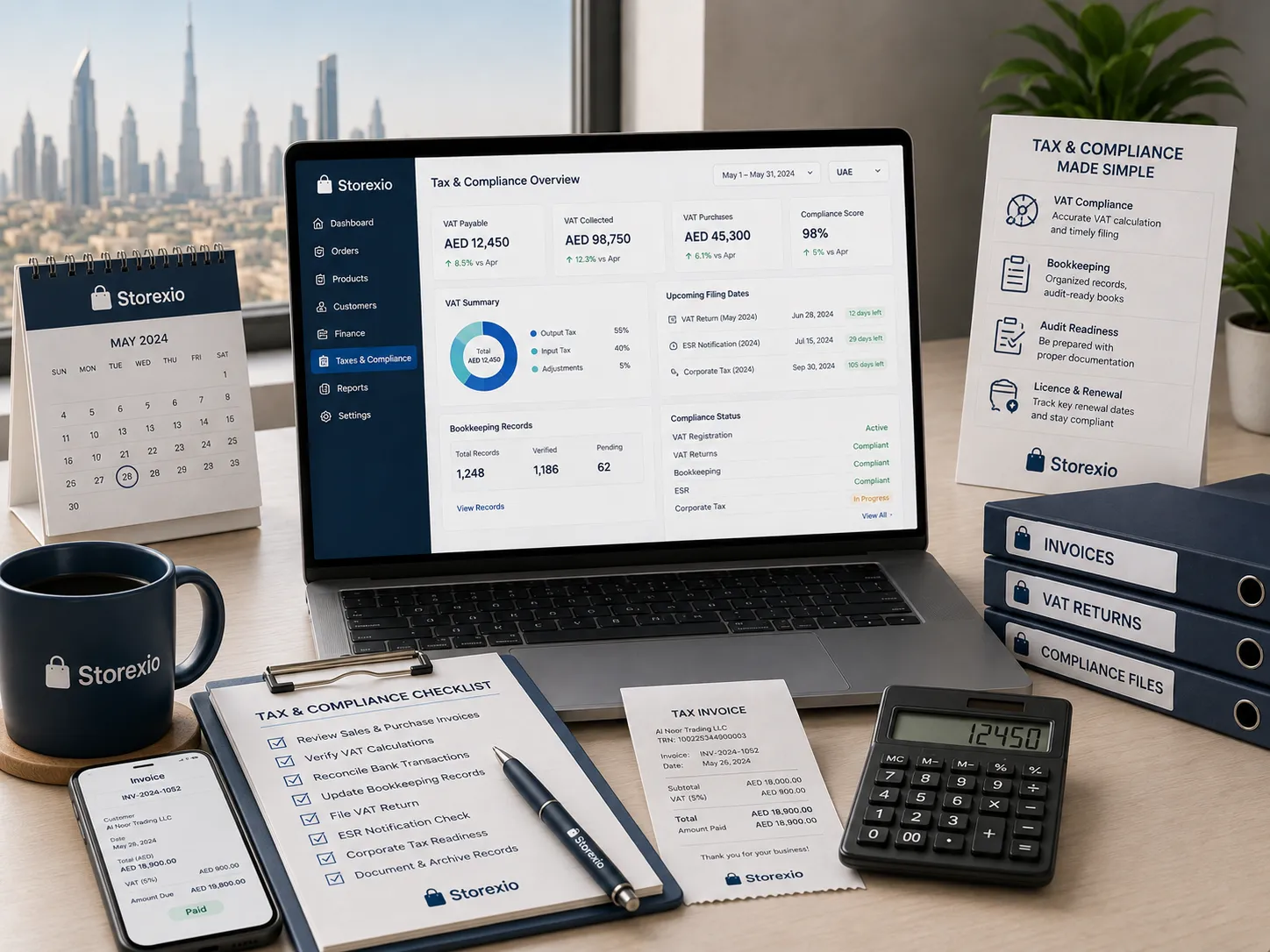
Tax should not be confused with your initial ecommerce website cost, but it needs to be considered as the business grows.
For UAE-resident businesses, mandatory VAT registration generally applies when taxable supplies and imports exceed AED 375,000, or are expected to exceed the threshold within the relevant period.
Voluntary VAT registration is available from AED 187,500 when the applicable conditions are met.
Corporate Tax rules are separate and depend on the taxable person and circumstances.
For general UAE businesses, the standard Corporate Tax framework applies 0% to taxable income up to AED 375,000 and 9% to the portion exceeding AED 375,000, subject to the applicable rules, exemptions and special free-zone provisions.
Do not wait until you cross a threshold before thinking about bookkeeping.
From your first orders, keep accurate records of:
sales, purchases, payment fees, refunds, inventory costs and operating expenses.
Clean records make growth much easier.
Three Realistic Online Store Budget Scenarios
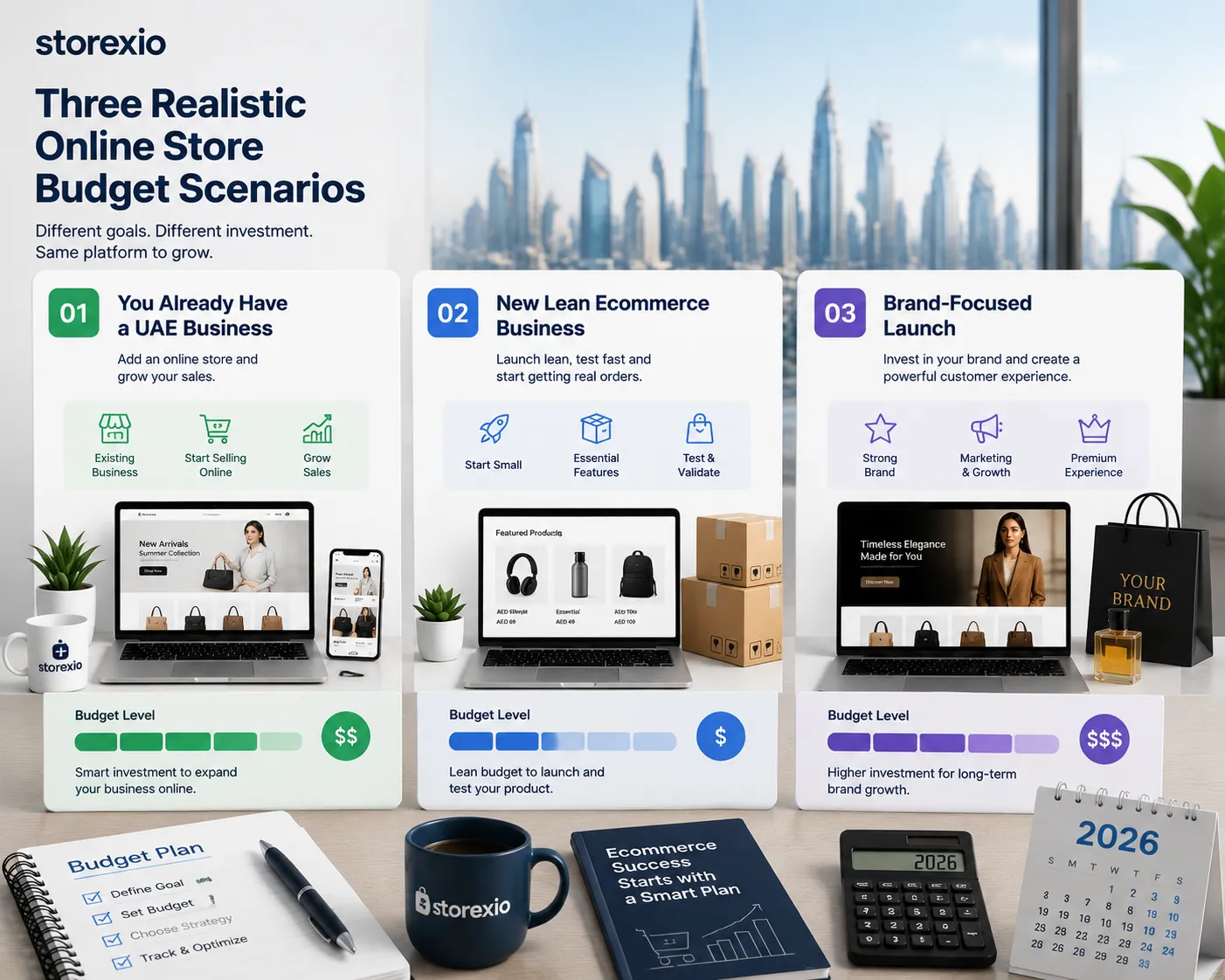
The easiest way to understand the total cost is to separate different types of founders.
Scenario 1: You Already Have a UAE Business
Imagine you already own a licensed perfume shop, fashion boutique, electronics shop or other retail business.
You already have:
a license + products + business bank account + brand + physical inventory.
Your ecommerce launch may mainly require:
Storexio: AED 0–79+ per month depending on the plan you choose
Domain: approximately AED 50–150+ per year depending on extension and registrar
Content: DIY initially
Marketing: your chosen testing budget
In this situation, adding ecommerce can be relatively inexpensive because you are digitising an existing business rather than creating an entirely new one.
Scenario 2: New Lean Ecommerce Business
Now imagine you are starting completely from zero.
Your startup budget needs to cover:
licensing + first inventory + online store + domain + packaging + marketing + contingency.
With publicly advertised licensing examples alone ranging from approximately AED 5,750 to AED 12,500+, a practical lean first-year budget can quickly move above AED 7,000–15,000 before significant inventory or marketing.
That does not mean you must spend AED 15,000.
It means the legal business setup—not the website—is often the biggest barrier to an ultra-low-cost launch.
Scenario 3: Brand-Focused Launch
Suppose you want:
professional photography,
large opening inventory,
custom packaging,
paid advertising,
influencer content,
premium branding,
and a more developed product range.
Your budget can easily move into AED 20,000–40,000+ territory.
But this is a business decision, not a requirement for having an online store.
Do not confuse:
“what a mature brand could spend”
with:
“what I need to spend to prove that customers will buy.”
Those are very different questions.
The Hidden Costs Most Ecommerce Budgets Miss
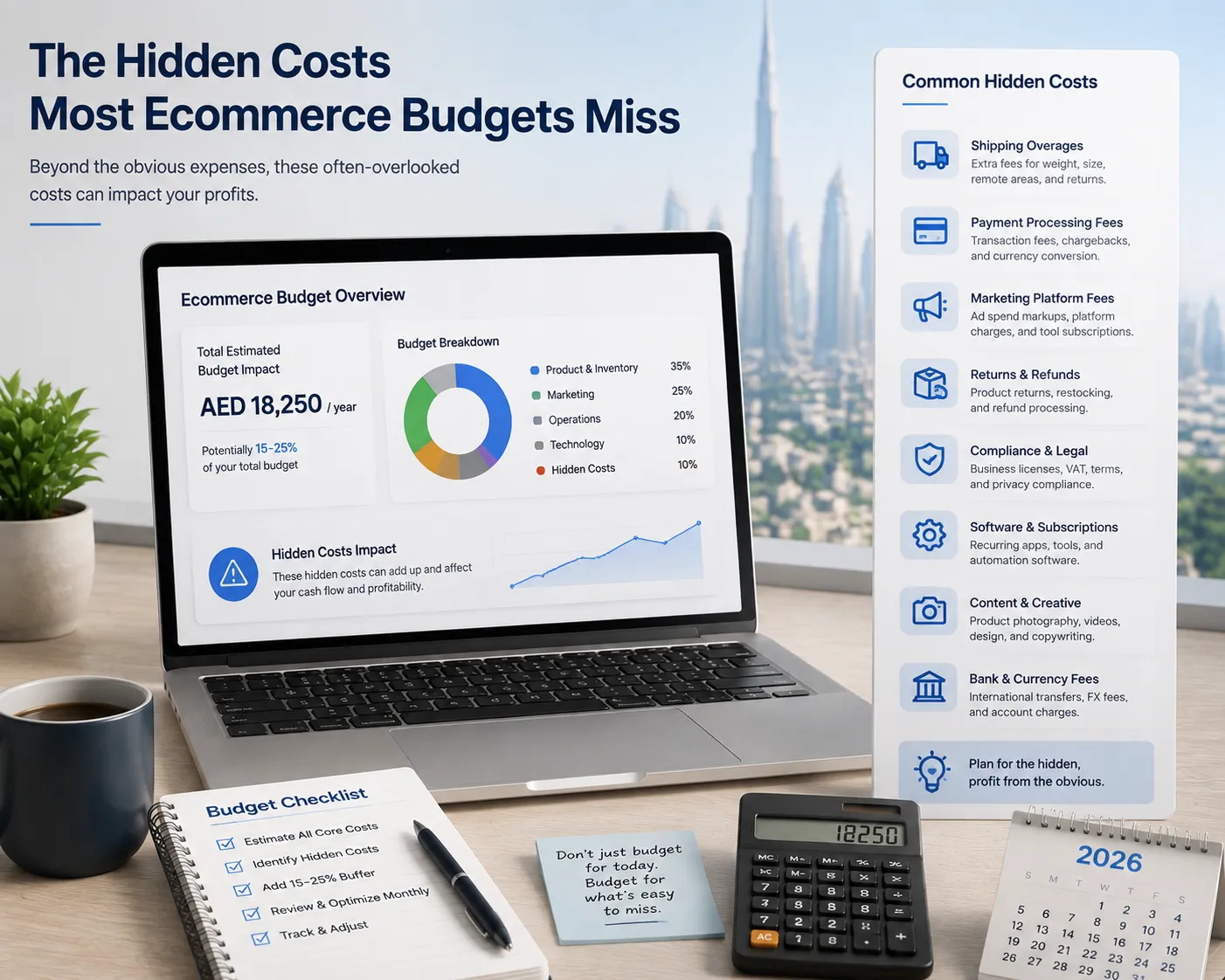
Some expenses do not appear until orders begin.
Failed Cash-on-Delivery Orders
A customer places a COD order but refuses the parcel or cannot be reached.
You may still pay delivery or return costs.
Returns and Exchanges
Fashion and other variation-heavy categories can experience frequent exchanges.
Your margin needs room for them.
International Card Charges
Some gateways charge more when the customer's card is issued outside the UAE.
Domain and License Renewal
Your first-year budget is not your only budget.
Domains, licenses and software need renewal.
Plugin and App Creep
Some ecommerce systems appear inexpensive until merchants install multiple paid applications for features that were not included in the core platform.
Always calculate the total operating stack, not only the base subscription.
Excess Inventory
Unsold inventory quietly locks your cash away.
For a small ecommerce business, buying too much of an unproven product can be much more damaging than spending AED 100 extra on software.
Where Should You Spend More — and Where Should You Save?
Spend where customers notice or where the business could fail.
That generally means prioritizing:
product quality, clear product information, reliable fulfilment, trustworthy checkout, mobile experience and customer service.
Be more conservative with:
expensive custom development before product validation, oversized opening inventory, premium packaging before consistent orders and broad advertising campaigns without testing.
A new ecommerce business should preserve cash for learning.
Your first version does not need to be your final version.
Can You Start an Online Store in the UAE for Less Than AED 10,000?
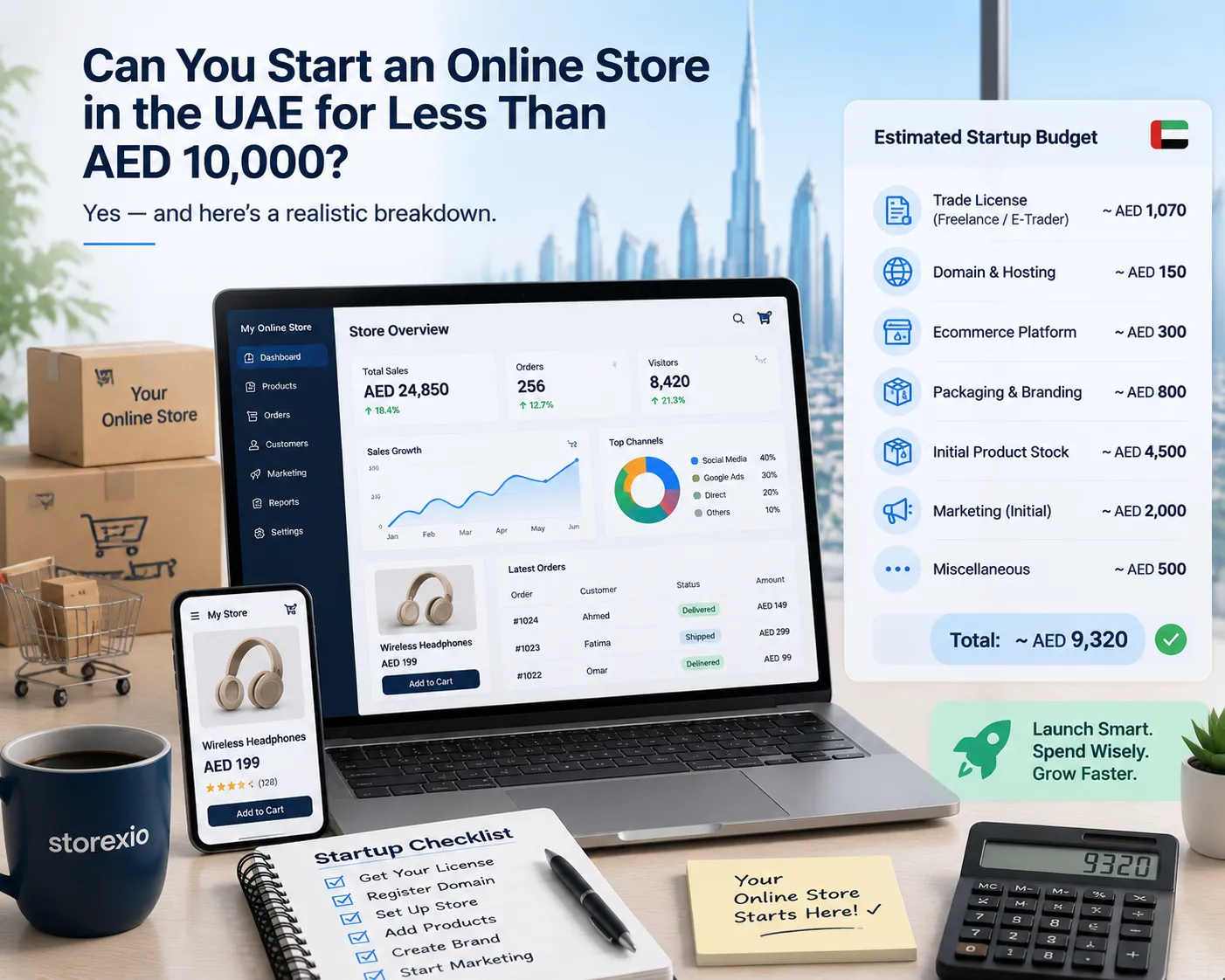
Yes, in some situations.
If you already have the appropriate business license and products, your incremental ecommerce cost can be far below AED 10,000.
If you need to establish a completely new company, the answer depends heavily on your license package, activities, visas and inventory.
Some current free-zone packages begin below AED 10,000, which can make a lean launch possible.
But you should not build your budget around the license price alone.
Remember to leave money for:
products, packaging, delivery, marketing and unexpected expenses.
Starting with AED 9,900 and spending AED 9,800 before launch leaves you with a technically functioning business and almost no working capital.
That is not a strong position.
A Better Way to Set Your Ecommerce Budget
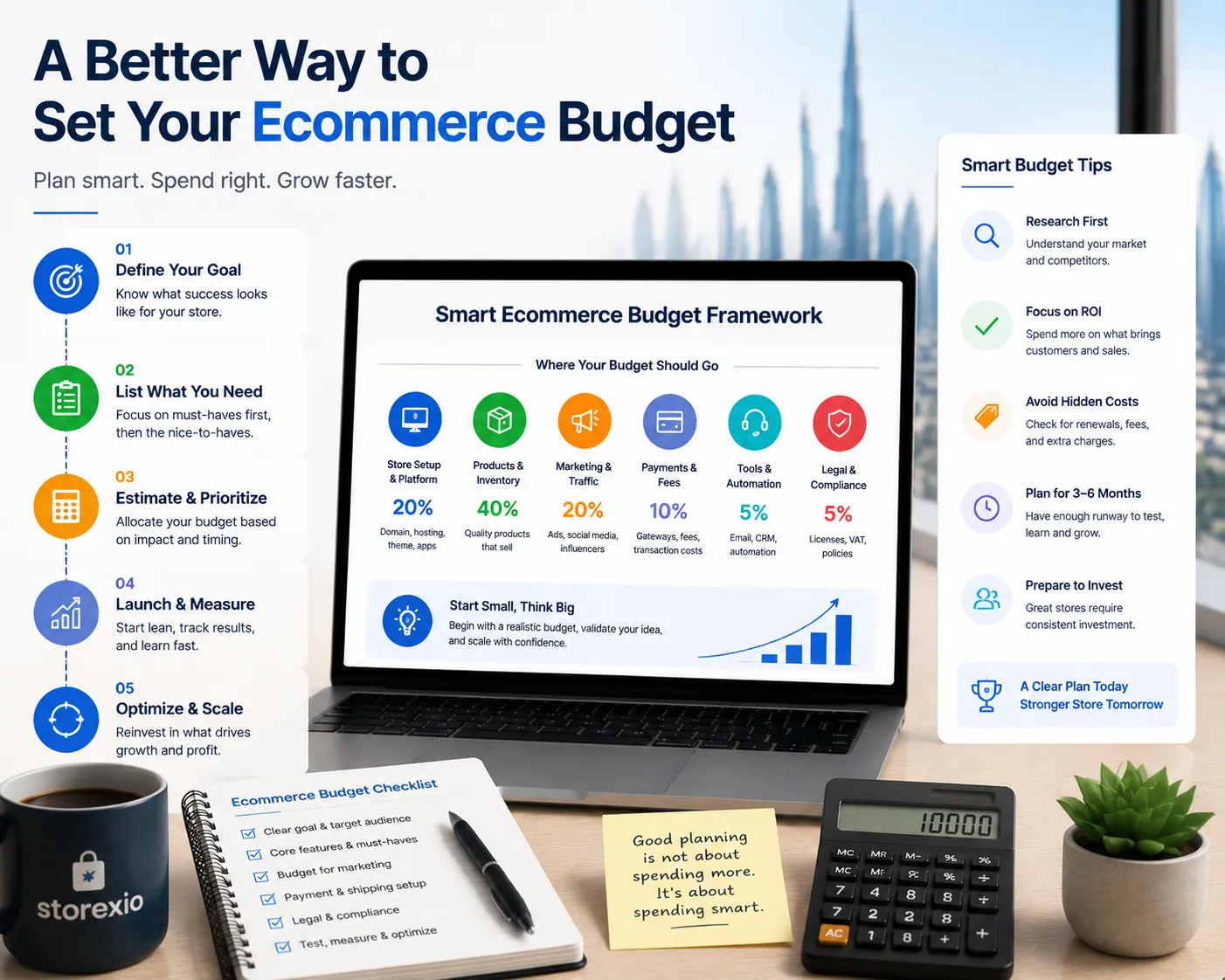
Instead of asking:
“What is the cheapest way to create an online store?”
ask:
“What is the smallest amount I need to test my business properly?”
For example:
Step 1: Choose a small product range.
Step 2: Confirm your licensing requirement.
Step 3: Launch with a ready ecommerce platform instead of unnecessary custom development.
Step 4: Use simple product photography.
Step 5: Configure your payment and delivery options.
Step 6: Test a small marketing budget.
Step 7: Measure actual orders.
Step 8: Invest more only where the data justifies it.
This approach turns your startup budget into an experiment rather than a gamble.
If you still need to plan the complete launch process, read our step-by-step guide to starting an online store in the UAE.
How Storexio Helps Reduce the Technical Cost of Launching
Storexio was built for UAE merchants who want a professional ecommerce storefront without starting with a custom development project.
Instead of separately arranging a storefront, catalog system, order dashboard, themes and other basic ecommerce infrastructure, Storexio provides the core structure in one ecommerce platform for UAE businesses.
Depending on your plan, Storexio can provide capabilities such as:
product and category management,
ready storefront themes,
mobile-friendly shopping,
order management,
custom domains,
discounts and campaigns,
Arabic and English options,
analytics,
and configurable payment workflows.
For someone testing ecommerce for the first time, Storexio's Free plan can reduce one of the initial cost barriers.
As the business grows, merchants can move to paid plans when they actually need larger catalogs or additional functionality.
The objective is simple:
Spend more money on growing the business—not on rebuilding basic ecommerce infrastructure from scratch.
Final Cost Checklist
Before launching, make sure your budget covers these eight areas:
- Business licence and required approvals
- Online store/ecommerce platform
- Domain
- Opening inventory
- Product content and packaging
- Payments and delivery
- Marketing
- Working-capital reserve
If one of these is missing, your startup budget is probably incomplete.
Frequently Asked Questions
How much does it cost to start an online store in the UAE?
There is no fixed total. If you already have a suitable UAE business license and products, you may be able to launch the digital side of your business for a relatively small amount using a ready ecommerce platform. If you are creating a new company, current publicly advertised free-zone license examples start from roughly AED 5,750 and can exceed AED 12,500 before inventory, marketing and other optional costs.
How much does an ecommerce license cost in the UAE?
The amount varies by emirate, jurisdiction, activities, visa requirements and business structure. Current free-zone examples range from approximately AED 5,750 at the lower end to AED 12,500+ for other packages. Always request an exact quotation based on your intended business activities.
Do I need a license to sell online in the UAE?
Generally, yes. UAE ecommerce businesses need the appropriate license and approvals for the activities they conduct. This applies to ecommerce through websites and can also apply to commercial activity through apps, social media and digital marketplaces.
What is the cheapest way to create an ecommerce website in the UAE?
Using a ready ecommerce platform can significantly reduce the technical startup cost compared with commissioning a custom system. Storexio currently offers a Free plan, allowing eligible merchants to begin building and testing a storefront before moving to a paid plan.
How much does Storexio cost?
As of August 2026, Storexio has a Free plan. Paid plans currently begin at AED 79 per month, with higher plans available for merchants who need larger catalogs and additional ecommerce functionality. Always check the latest pricing before choosing your plan.
Do I need a .ae domain for my UAE online store?
No. You can use other domain extensions such as .com. However, a .ae domain can give your business a clearly UAE-focused web identity. Domain pricing varies by registrar.
How much should I budget for online payments?
This depends on your payment gateway. As one benchmark, Stripe currently lists standard UAE domestic card processing at 2.9% + AED 1 per successful transaction. Compare transaction fees, setup fees, international-card costs, payouts and other charges before choosing a provider.
Should I build a custom ecommerce website from the beginning?
Not necessarily. Custom development makes sense when your business has requirements that standard ecommerce platforms cannot support. For many new merchants, launching on a ready platform first allows them to validate products and customer demand before investing heavily in custom technology.
Can I start ecommerce without buying a lot of inventory?
Yes. Many businesses benefit from testing a smaller product selection first. A focused catalog can help you identify which products customers actually want before you commit more cash to inventory.
When do I need to register for VAT in the UAE?
For UAE-resident businesses, VAT registration is generally mandatory once taxable supplies and imports exceed AED 375,000, or are expected to exceed the applicable threshold within the specified period. Voluntary registration may be available from AED 187,500 when the relevant conditions are met.
Start With a Store, Then Invest Where Customers Respond
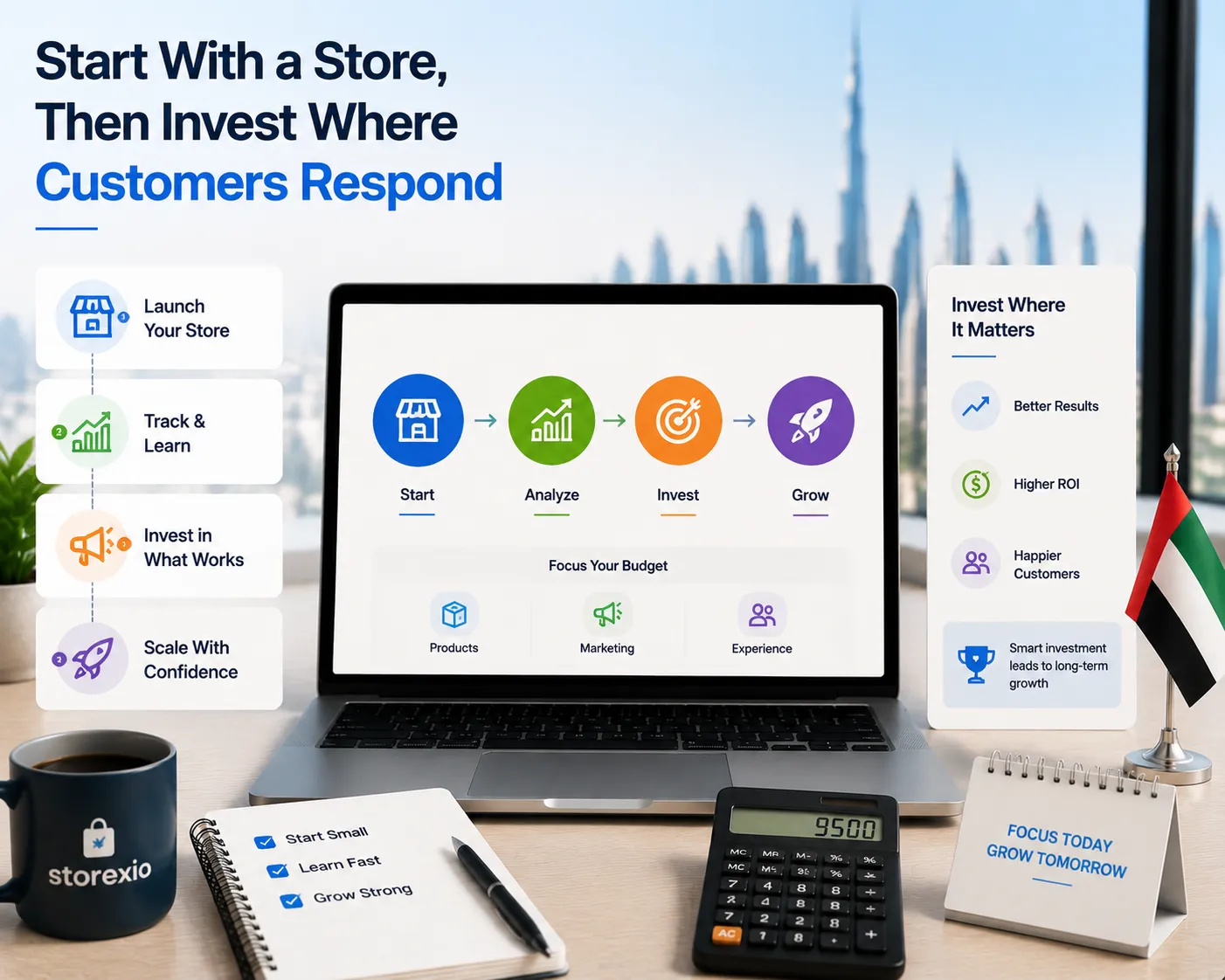
Starting an online store in the UAE does not have to begin with an expensive website.
The biggest costs usually depend on the business itself:
your license, products, inventory, logistics and ability to acquire customers.
Technology should help you control those costs—not become another unnecessary obstacle.
If your products, business details and delivery plan are ready, you can create your online store in the UAE with Storexio, start with a professional storefront, and improve the business as real customer data comes in.
Start small. Learn quickly. Invest in what sells.
Comments
No comments yet. Be the first to share your thoughts.
Leave a Comment